HR
HR EN
ENYuri Bezmenov: Ideological Subversion Explained
- Category: Parenting
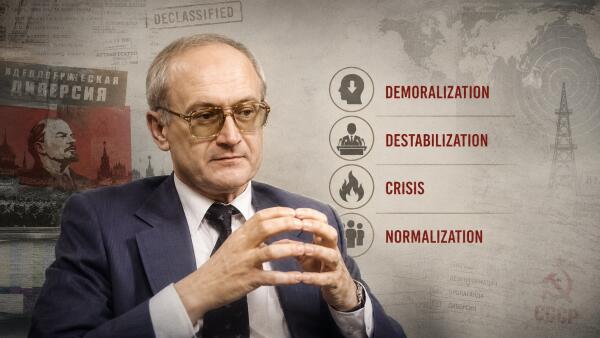
YURI BEZMENOV AND THE FOUR STAGES OF IDEOLOGICAL SUBVERSION
Yuri Bezmenov’s interview on the four stages of ideological subversion is one of the most frequently rediscovered Cold War recordings on the internet. In it, Bezmenov described a long-term process by which a hostile power could weaken a society from within, not mainly through spies stealing secrets, but through propaganda, influence, manipulation of public opinion, and the erosion of trust in institutions. His four stages were demoralization, destabilization, crisis, and normalization.
The interview is compelling because it offers a simple framework for a complex subject. It gives names to things many people worry about today: information overload, social fragmentation, distrust of media, ideological conflict, institutional weakness, and public confusion. But that simplicity is also the reason the interview must be handled carefully. Bezmenov’s model can help readers think about propaganda and psychological warfare today.
A balanced reading requires three distinctions. First, there is what Bezmenov personally claimed in the 1984 interview and in his writings. Second, there is what is historically documented about Soviet active measures, propaganda, and disinformation. Third, there is modern interpretation, where commentators apply Bezmenov’s framework to current political debates, sometimes responsibly and sometimes sensationally.
Historically, Soviet active measures were real. Researchers and security scholars describe them as influence and subversion operations involving disinformation, front organizations, support for friendly political movements, manipulation of narratives, and efforts to weaken adversaries. Mark Galeotti, writing for the George C. Marshall European Center for Security Studies, notes that the Soviet term aktivnye meropriyatiya was used from the 1950s onward for covert and deniable political influence operations, and that KGB Service A was its primary active-measures department.
WHO WAS YURI BEZMENOV?
Yuri Alexandrovich Bezmenov, later known in the West as Tomas David Schuman, was a Soviet journalist and defector. His own writings state that he was born in Moscow in 1939, studied at the Institute of Oriental Languages, worked for Novosti, spent time in India, and eventually defected to the West. In Love Letter to America, published under the name Tomas D. Schuman, the author biography describes him as a former Novosti employee who worked in India and later escaped by disguising himself and joining a tour group before reaching Athens and eventually Canada.
The 1984 interview gives a similar account. Bezmenov said he worked in New Delhi as a Soviet press officer, planned an unusual defection, disguised himself as a hippie, left India, was debriefed by U.S. intelligence in Athens, and then settled in Canada. He also said he studied political science at the University of Toronto and later worked for the Canadian Broadcasting Corporation’s international service.
Canada Declassified, a University of Toronto digital repository that includes official Canadian intelligence files released under access-to-information law, describes Bezmenov as a journalist with the Soviet state-sponsored Novosti Press Agency whose unofficial duties included propaganda and subversion work for the KGB. The same source notes that he was resettled in Canada under the name Thomas Schuman and that his later relationship with Canadian intelligence became strained.
His personal story matters because his authority rests largely on lived experience. He was not writing as a neutral historian. He was a defector, anti-Soviet speaker, and political activist who believed he had seen Soviet propaganda methods from the inside. That gives his testimony value, but it also means his claims should be tested against independent evidence.
WHAT WAS THE 1984 INTERVIEW ABOUT?
The interview most often shared online was conducted by G. Edward Griffin in 1984 and is commonly circulated under titles such as Soviet Subversion of the Free World Press or The Four Stages of Ideological Subversion. The YouTube version provided in the prompt presents the full interview and frames it around Bezmenov’s explanation of ideological subversion.
In the interview, Bezmenov argued that Western audiences misunderstood the KGB by focusing too much on espionage. He said spy stories were dramatic and marketable, but that the larger objective was influence. In his words, ideological subversion, active measures, or psychological warfare meant changing people’s perception of reality so deeply that, even with abundant information, they could not make sensible conclusions in the interests of themselves, their families, their communities, or their country.
This is the central idea of the interview: propaganda is not simply a lie told once. It is a long-term process of shaping assumptions, incentives, vocabulary, emotions, identity, and trust. In Bezmenov’s view, once that process succeeds, facts alone no longer persuade because people interpret facts through a damaged framework.
The interview should also be understood as a Cold War artifact. It was produced in the early 1980s, during renewed U.S.-Soviet tension, after the détente period had faded and before the reforms of Mikhail Gorbachev. Bezmenov spoke as an anti-communist defector warning an American audience. His language was often forceful, ideological, and apocalyptic. A modern reader can learn from it without adopting every assumption or conclusion.
WHAT DOES “IDEOLOGICAL SUBVERSION” MEAN?
In Bezmenov’s usage, ideological subversion meant a long-term campaign to weaken a society’s ability to understand itself, defend its institutions, and respond coherently to threats. He presented it as mostly open and legal rather than secret. He emphasized education, media, culture, elite opinion, and public attitudes more than hidden spy networks.
This idea overlaps with the broader historical concept of active measures. Active measures were not limited to newspaper propaganda. They could include forgeries, rumor campaigns, front organizations, agents of influence, covert media manipulation, political support operations, and the exploitation of existing conflicts. Galeotti describes active measures as operations ranging from disinformation and corruption to assassination and sponsorship of coups, while also noting that such measures often work by exploiting weaknesses that already exist in a target society.
That last point is essential. Influence operations rarely create social divisions from nothing. They usually identify cracks, amplify grievances, distort facts, promote distrust, and encourage people to view opponents as enemies. A foreign actor may exploit racial tension, class conflict, religious fear, corruption, public-health anxiety, or distrust of elites, but those tensions often have domestic roots.
For this reason, ideological subversion should not be treated as a magical explanation. A society can suffer from polarization, institutional failure, inequality, corruption, bad journalism, or poor education without those problems being created by a foreign intelligence service. The useful question is not “Is every problem foreign subversion?” but “How can propaganda exploit real problems and make them harder to solve?”
STAGE ONE: DEMORALIZATION
Bezmenov described demoralization as the longest stage. He said it could take 15 to 20 years because that is roughly the time needed to educate a generation. In his view, the goal was to weaken a society’s confidence in its own values, institutions, history, and sense of reality. He argued that once people were demoralized, facts would no longer change their minds.
In simple terms, demoralization means the erosion of a shared civic foundation. It does not necessarily mean that everyone becomes depressed or immoral. In Bezmenov’s model, it means that citizens lose the ability to agree on basic truths, common interests, or legitimate institutions. They may become cynical, reactive, alienated, or ideologically rigid.
Education was central to Bezmenov’s explanation. He claimed that Marxist-Leninist ideas had been introduced into American education and public life without adequate challenge. That claim is one of the most controversial parts of the interview. It reflects his anti-communist worldview and his belief that Western intellectuals were especially vulnerable to Soviet influence. Some Soviet efforts to influence intellectuals, journalists, and activists are historically documented, but Bezmenov’s broad implication that large parts of American education were effectively “programmed” by hostile ideology is an interpretation, not a settled historical fact.
A more careful modern reading is that demoralization can occur whenever citizens lose trust in the methods that allow disagreement to remain productive. These methods include honest debate, reliable institutions, independent journalism, transparent courts, academic standards, peaceful transfer of power, and the ability to separate evidence from identity. Propaganda attacks these habits by encouraging people to believe that all institutions are corrupt, all opponents are traitors, all news is fake, and all compromise is weakness.
Demoralization also thrives on information overload. A person who sees endless claims, counterclaims, scandals, leaks, conspiracy theories, and emotionally charged headlines may stop trying to distinguish truth from falsehood. This is different from being fooled by one false story. It is a deeper condition in which people become exhausted and conclude that truth itself is inaccessible.
STAGE TWO: DESTABILIZATION
Bezmenov’s second stage was destabilization. He said this stage could take two to five years and would focus less on ideology in the abstract and more on essential systems: the economy, foreign relations, and defense. In his model, once a population had been demoralized, the next task was to weaken the practical pillars that allow the state to function.
Destabilization is best understood as pressure on core institutions. A society may still have elections, courts, media, universities, businesses, and security agencies, but public confidence in them becomes fragile. Economic anxiety grows. Foreign-policy consensus weakens. Defense and security decisions become polarized. Political factions begin to treat each other not as rivals within a shared system, but as existential threats.
From an influence-operations perspective, destabilization does not require inventing every problem. It can involve amplifying existing disputes. A foreign actor may push contradictory messages to different audiences: telling one group that the system is oppressive and another that reformers are enemies of the nation. The goal is not necessarily to make everyone believe the same lie. It may be enough to make people distrust each other so deeply that collective action becomes impossible.
This is where Bezmenov’s model connects most clearly to modern concerns about disinformation. Online platforms can accelerate destabilization by rewarding outrage, simplifying identity conflicts, and allowing false narratives to travel quickly across communities. Yet the technology is only part of the story. The deeper issue is whether citizens and institutions have enough trust, transparency, and resilience to correct errors without collapsing into paranoia.
STAGE THREE: CRISIS
The third stage in Bezmenov’s model was crisis. He described it as short and intense, possibly lasting only weeks, and involving a dramatic breakdown or turning point. In his Cold War framing, crisis could open the way for a violent change of power or a radical restructuring of society.
A crisis is a moment when normal decision-making fails. It may be triggered by war, economic collapse, political violence, contested legitimacy, institutional paralysis, or mass panic. The key feature is compression: events move faster than institutions can respond, and frightened people become more willing to accept extreme solutions.
Propaganda is especially powerful during crisis because people seek certainty. When fear is high, simple explanations become attractive. A population may become more receptive to scapegoats, emergency powers, censorship, conspiracy theories, or promises of instant restoration. In such moments, the public may reward the loudest or most emotionally satisfying narrative rather than the most accurate one.
Still, caution is needed. Not every crisis is the result of subversion. Democracies, empires, and states have suffered crises for many reasons: economic mismanagement, corruption, war, natural disaster, public-health failures, social inequality, and leadership mistakes. Bezmenov’s framework is most useful when it asks how hostile actors exploit a crisis, not when it assumes they caused it.
STAGE FOUR: NORMALIZATION
The final stage was normalization. Bezmenov used the term cynically, referring to the language of Soviet power after the 1968 Warsaw Pact invasion of Czechoslovakia. In the interview, he said “normalization” meant the new order after crisis, when the situation is presented as stabilized even if freedom has been reduced.
The historical reference matters. After the Prague Spring, Soviet-led Warsaw Pact forces invaded Czechoslovakia in August 1968 to stop reformist trends. The U.S. Office of the Historian describes the invasion as an effort to crack down on reforms in Prague. :contentReference[oaicite:13]{index=13} Britannica notes that, in the aftermath, Gustáv Husák pursued a process of “normalization” intended to purge the effects of the Prague Spring and restore alignment with the Soviet bloc.
In Bezmenov’s framework, normalization is not a return to healthy normal life. It is the consolidation of a new political reality after a crisis has weakened resistance. The language of order, safety, unity, or emergency recovery may be used to justify permanent changes. Institutions are restructured. Dissent is marginalized. Citizens adapt to the new conditions because they are tired, afraid, or convinced that no alternative exists.
For modern readers, the lesson is not that every government action during a crisis is tyranny. Democracies sometimes need emergency measures. The question is whether those measures remain lawful, limited, transparent, accountable, and reversible. A resilient society can respond to crisis without abandoning the principles that give it legitimacy.
WHY THE INTERVIEW BECAME POPULAR AGAIN
Bezmenov was not a major mainstream figure during his lifetime. Canada Declassified notes that his message gained limited currency while he was alive, but decades after his death in 1993, his warnings about Soviet disinformation began attracting millions of views on YouTube. The same source connects his renewed visibility to modern debates over fake news and to the use of his recordings in a New York Times video series and a Call of Duty: Black Ops Cold War trailer.
The reason is not hard to understand. The internet has made propaganda easier to distribute, remix, and personalize. Social media allows emotionally charged clips to travel without context. A short excerpt from Bezmenov can feel prophetic when viewed during periods of political polarization, public distrust, war, pandemic fear, or institutional crisis.
His interview also offers a narrative structure. The four stages sound orderly and predictive. They give viewers the feeling that chaotic events can be explained by a hidden sequence. That is part of the appeal, but it is also a risk. Good historical analysis should clarify complexity, not replace it with a single master theory.
When the interview is shared responsibly, it can introduce readers to real Cold War practices such as active measures, disinformation, and psychological operations. When shared irresponsibly, it can become a tool for accusing political opponents of being brainwashed, treasonous, or foreign-controlled without evidence. That misuse contradicts the media-literacy lesson the interview should inspire.
WHAT BEZMENOV GOT RIGHT
Bezmenov was right that influence operations can matter as much as secret espionage. Declassified materials, scholarly research, and historical case studies show that Soviet and Soviet-bloc services invested in propaganda, disinformation, front groups, and narrative manipulation. The KGB did not merely steal documents; it also tried to influence how people interpreted events.
He was also right that propaganda is not always obvious. It can appear as commentary, activism, expert opinion, cultural messaging, forged evidence, selective truth, or emotionally powerful storytelling. The most effective propaganda often contains enough truth to feel credible while directing audiences toward a misleading conclusion.
He correctly emphasized institutions. Education, journalism, public trust, courts, elections, and civic culture are not decorative features of a free society; they are defensive infrastructure. A society that cannot distinguish evidence from rumor, criticism from sabotage, or disagreement from treason becomes vulnerable to manipulation.
He also understood that information alone does not automatically persuade. Modern research on misinformation supports the idea that people often evaluate claims through identity, emotion, group loyalty, and prior beliefs. That does not mean facts are useless. It means facts need trustworthy channels, patient explanation, and institutions people still consider legitimate.
THE NEW SUBVERSION DOES NOT WEAR A UNIFORM
The modern West is not being conquered by one flag, one party, or one foreign ideology marching through the streets with banners.
That is the lazy version of the story.
The sharper version is uglier: modern societies are being reshaped from inside their own institutions, by people who speak the language of compassion while building systems of control.
The old fear was infiltration. The new reality is saturation.
It comes through schools, universities, streaming platforms, HR departments, NGOs, courts, public broadcasters, advertising agencies, algorithmic feeds, and bureaucracies that claim to be “protecting democracy” while quietly narrowing the range of acceptable thought.
This is not classic communist subversion. It does not need hammer-and-sickle posters. It does not need secret agents whispering in basements. It has better tools now.
It has moral branding.
It has corporate compliance.
It has social media mobs.
It has “safety” policies.
It has “misinformation” labels.
It has “inclusion” departments.
It has the power to make ordinary people afraid to say what they can see with their own eyes.
That is the heart of modern ideological subversion: control language, redefine morality, fragment identity, weaken family and tradition, present radical social engineering as compassion, then brand resistance as hatred, extremism, misinformation, or backwardness.
A society does not have to be defeated by an army if it can be trained to distrust itself.
DEMORALIZATION: TEACH PEOPLE TO DESPISE THEIR OWN FOUNDATIONS
Demoralization does not begin with tanks. It begins with curriculum.
It begins when children are taught to see their inheritance not as something to understand, refine, and defend, but as a crime scene. Their history becomes nothing but oppression. Their religion becomes superstition or bigotry. Their family structure becomes “normative violence.” Their national identity becomes shameful. Their ancestors become suspects. Their own instincts become politically dangerous.
The goal is not education. The goal is severance.
A demoralized society is one in which people no longer know what they are allowed to love.
In the United States and Europe, this process often hides under therapeutic language. Nobody says, “We are dismantling your civilization.” They say, “We are deconstructing harmful narratives.” Nobody says, “We are replacing moral inheritance with institutional ideology.” They say, “We are promoting inclusion.” Nobody says, “We are training your children to distrust their parents.” They say, “We are creating safe spaces.”
The words are soft. The effect is hard.
Schools and universities increasingly function not only as places of learning, but as ideological sorting machines. Students are not merely taught mathematics, literature, science, history, or philosophy. They are trained in what assumptions are respectable. They learn which questions cost them status. They learn which words are forbidden. They learn which identities are sacred and which are permanently guilty.
That is not critical thinking. That is ritual conditioning.
Media, advertising, and entertainment reinforce the same vocabulary. Every commercial becomes a sermon. Every corporate logo becomes a flag. Every television drama must display the approved moral hierarchy. Every children’s franchise is pressured to carry the latest ideological message. Every institution chants the same slogans until disagreement feels not merely wrong, but socially radioactive.
Corporate HR culture has become one of the most underestimated engines of this transformation. The workplace used to be where people worked. Now, in many institutions, it is where adults are subjected to ideological instruction disguised as professional development. Employees are not asked only to treat colleagues with dignity, which is reasonable. They are asked to affirm contested political, moral, and anthropological claims as a condition of belonging.
This is where gender ideology, sexuality politics, and identity politics become central examples.
Private individuals deserve dignity, privacy, and protection from cruelty. That should not be controversial. But institutional ideology is something else. It is not content with tolerance. It demands affirmation. It is not content with equal treatment. It demands linguistic obedience. It is not content with protecting people from harassment. It seeks to punish disagreement with metaphysical claims about sex, family, childhood, medicine, language, and the human person.
The trick is to smuggle radical cultural change inside moral vocabulary.
“Inclusion” becomes agreement.
“Diversity” becomes ideological sameness.
“Safety” becomes protection from dissent.
“Rights” become weapons against reality.
“Compassion” becomes coercion.
Compassion becomes manipulative when it forbids disagreement.
That sentence matters. Real compassion can survive argument. Fake compassion needs censorship. Real compassion respects people as moral agents. Fake compassion treats people as props in a political drama. Real compassion helps the vulnerable without demanding that everyone else surrender language, memory, conscience, and common sense.
The issue is not whether society should be cruel to minorities. It should not. The issue is whether institutions can use vulnerable people as shields for elite ideological projects. That is exactly what happens when disagreement is framed as harm, skepticism as hatred, and reality-testing as violence.
Once that move succeeds, debate is over before it begins.
The citizen is no longer asked, “What do you think?”
He is asked, “Why are you dangerous?”
This is how people are trained to debate inside a controlled vocabulary. They think they are arguing freely, but the key words have already been captured. “Equality,” “justice,” “freedom,” “hate,” “extremism,” “misinformation,” “democracy,” “rights,” “violence,” and “safety” are redefined by institutions, then handed back to the public as moral law.
The public still speaks. But it speaks in someone else’s cage.
DESTABILIZATION: BREAK TRUST, THEN MANAGE THE FRAGMENTS
A demoralized society is easier to destabilize because it no longer has shared foundations.
People who do not trust their history, institutions, neighbors, families, borders, churches, schools, media, or biological reality are easy to push into permanent conflict. They are not citizens anymore. They are competing grievance blocs.
Modern destabilization is not one crisis. It is the constant multiplication of pressure points.
Economic insecurity. Housing costs. Inflation. Mass migration. Cultural fragmentation. Declining trust. Censorship debates. Crime narratives. War anxiety. Election panic. Online polarization. Institutional hypocrisy. Media manipulation. Moral exhaustion.
Each one weakens the social nervous system.
In Europe, mass migration has become one of the clearest examples of elite failure turned into social conflict. Migration involves real human beings, not abstractions. Migrants are not the enemy. But the political class has spent years pretending that any serious concern about borders, integration, crime, cultural cohesion, welfare pressure, or national identity is automatically xenophobia. Then, when public anger rises, the same elites act shocked.
The same pattern plays out across other issues.
Men are told they are defective women or latent predators.
Women are told that their sex-based concerns are bigotry.
The young are told the old stole their future.
The old are told the young are spoiled and ungrateful.
Native citizens are told borders are immoral.
Migrants are told the native population hates them.
Religious people are told they are dangerous reactionaries.
Secular liberals are told every traditional belief is a threat.
The left is told the right is fascist.
The right is told the left is totalitarian.
Everyone is told someone else is coming to destroy them.
This is not accidental. Permanent conflict benefits managers.
A population divided into hostile tribes does not organize around shared interests. It does not ask why wages stagnate while asset prices rise. It does not ask why bureaucracies grow while families shrink. It does not ask why corporations celebrate “diversity” while crushing small competitors. It does not ask why public institutions lecture citizens about morality while failing at basic competence.
Instead, everyone screams at everyone else.
Algorithmic platforms intensify the process. They reward outrage, humiliation, fear, and tribal performance. They turn politics into identity theater. They turn private insecurity into public combat. They make every issue feel apocalyptic and every opponent feel inhuman.
The result is a society that cannot relax.
And exhausted people are easier to manage.
CRISIS: FEAR IS THE GREAT ACCELERATOR
Crisis is where the machinery becomes visible.
Under normal conditions, people resist sudden changes to speech, law, surveillance, policing, education, money, borders, and war policy. In crisis, they accept what they would have rejected six months earlier.
Fear compresses debate.
Wars, pandemics, terrorism, economic shocks, energy crises, election panic, and moral emergencies all serve the same political function: they create permission for acceleration.
This does not mean every crisis is fake. That is a childish way to think. Wars are real. Viruses are real. Terrorist attacks are real. Inflation is real. Energy shortages are real. Political violence is real. The question is not whether crises exist. The question is what institutions do with them.
The answer, again and again, is expansion of power.
During the COVID-19 period, many governments imposed lockdowns, restricted access to public spaces, expanded public-health monitoring, and normalized emergency governance in ways that would have been politically explosive before the crisis.
Again, the point is not that disease is imaginary. The point is that crisis gives institutions a test environment for obedience.
Can people be locked down?
Can churches be closed?
Can protests be selectively condemned or excused?
Can speech be labeled dangerous?
Can platforms coordinate with authorities?
Can emergency rules become habits?
Can neighbors be trained to police neighbors?
Can shame do the work of law?
The answer, in many places, was yes.
War creates another version of the same pattern.
When war fever rises, complexity disappears. The world is reduced to saints and monsters. Atrocity coverage becomes selective. History begins yesterday. Diplomacy becomes betrayal. Skepticism becomes treason. Citizens are told that questioning escalation means supporting the enemy.
This is one of the oldest propaganda tricks in existence, and it still works because fear simplifies the mind.
Populations are emotionally prepared for conflict through moral storytelling. The enemy is not merely a rival state, regime, faction, or military actor. The enemy becomes evil itself. Once that frame is accepted, almost anything can be justified: censorship, surveillance, militarization, arms escalation, economic hardship, domestic crackdowns, and the punishment of dissent.
The same structure appears in domestic culture-war propaganda.
Question a foreign-policy escalation and you are accused of helping the enemy.
Question a gender policy and you are accused of endangering children.
Question immigration policy and you are accused of hating foreigners.
Question pandemic policy and you are accused of wanting people dead.
Question censorship and you are accused of defending extremism.
Question institutional narratives and you are accused of spreading misinformation.
Different issue. Same weapon.
Moral blackmail.
The goal is to narrow the space in which thought can occur.
A free society says: argue, persuade, challenge, test, doubt.
A managed society says: agree, repeat, signal, comply, or be marked.
NORMALIZATION: YESTERDAY’S RADICALISM BECOMES TODAY’S MANDATORY MORALITY
Normalization is the final insult.
After years of pressure, the public is told that the new order was always obvious, always decent, always inevitable.
Yesterday’s radical idea becomes today’s HR policy.
Yesterday’s activist slogan becomes today’s school lesson.
Yesterday’s fringe theory becomes today’s institutional training.
Yesterday’s censorship demand becomes today’s platform standard.
Yesterday’s emergency measure becomes today’s administrative tool.
Yesterday’s moral panic becomes today’s public morality.
And when people object, they are told: “Why are you still talking about this? Everyone already agrees.”
No, everyone does not agree. Many are silent.
They are tired. They have mortgages. They have children. They need jobs. They fear lawsuits. They fear losing friends. They fear being recorded. They fear being misquoted. They fear being turned into a headline. They fear being called hateful, extremist, ignorant, dangerous, or unemployable.
So they adapt.
They learn to nod.
They learn the slogans.
They learn which topics to avoid at dinner.
They learn which jokes are dead.
They learn which facts require disclaimers.
They learn which opinions must be whispered.
They learn that public life is theater and private life is refuge.
This is not consent. It is fatigue.
Normalization depends on repetition. Media repeats the new moral grammar. Corporations repeat it. Schools repeat it. Celebrities repeat it. NGOs repeat it. Bureaucracies repeat it. Platforms enforce it. Eventually, resistance feels not impossible, but socially expensive.
That is enough.
Most people are not heroes. Most people are busy, frightened, distracted, and financially exposed. They will not risk everything for a sentence. The managers know this.
The point is not to convince everyone.
The point is to make dissent lonely.
MODERN MEDIA: PROPAGANDA WITHOUT THE CARTOON VILLAIN
The most dangerous propaganda today is not always a lie.
Often, it is a frame.
A lie can be challenged. A frame is harder to see because it defines what counts as relevant before the argument begins.
Modern propaganda works through selection, omission, sequencing, tone, emotional headlines, image choice, algorithmic amplification, selective fact-checking, influencer mimicry, entertainment narratives, social pressure, and repetition.
It does not simply tell people what to think.
It tells them what kind of person they are if they think differently.
That is much more powerful.
State television is crude by comparison. The modern Western media system is more sophisticated because it is decentralized. No single editor has to command the whole machine. Journalists, activists, academics, NGO staffers, corporate communications teams, platform moderators, influencers, and entertainers often share the same class background, moral vocabulary, and status incentives. They do not need a conspiracy. They have consensus.
That consensus decides which stories become national emergencies and which disappear.
It decides which victims receive murals and which are footnotes.
It decides which riots are “mostly peaceful” and which protests are “threats to democracy.”
It decides which scandals prove systemic corruption and which are “complicated.”
It decides which statistics are amplified and which are buried.
It decides when context is necessary and when context is forbidden.
It decides when anger is righteous and when anger is extremism.
That distrust did not come from nowhere. It came from years of people noticing that media institutions often behave less like neutral observers and more like moral prosecutors.
Fact-checking, once a useful journalistic function, has often become another battlefield. The problem is not checking facts. Facts should be checked. The problem is selective checking: literalism for enemies, generosity for allies; microscopic scrutiny for one side, broad contextual forgiveness for the other.
A headline can be technically defensible and still manipulative.
An omission can be more dishonest than a falsehood.
A “mostly true” rating can launder a political narrative.
A “missing context” label can function as a warning sign to the public: do not share this thought.
Algorithmic platforms add another layer. They do not merely distribute information. They shape perception by deciding what appears, what trends, what is buried, what is demonetized, what is labeled, what is boosted, what is shadowed, and what becomes socially unavoidable.
People imagine censorship as a book burning. That is outdated.
Modern censorship is friction.
Your post is not deleted; it simply goes nowhere.
Your video is not banned; it is age-restricted.
Your account is not removed; it is demonetized.
Your argument is not answered; it is labeled.
Your reputation is not debated; it is contaminated.
This matters because the public square is now digital. Control the digital square, and you control the range of public courage.
The citizen is not always convinced.
He is exhausted.
She is distracted.
They are shamed.
They are isolated.
They are trained to self-censor before punishment is even necessary.
That is the genius of the new propaganda: it makes the prison internal.
WAR PROPAGANDA AND CULTURE-WAR PROPAGANDA USE THE SAME NERVOUS SYSTEM
War propaganda and domestic ideological propaganda look different on the surface, but they often operate through the same psychological machinery.
Both simplify.
Both moralize.
Both demand speed.
Both punish nuance.
Both rely on emotional images.
Both create sacred victims and untouchable narratives.
Both insist that hesitation helps the enemy.
In war, the public is told there are only two positions: support escalation or support evil. This is childish, but effective. It bypasses strategy, cost, history, diplomacy, corruption, unintended consequences, and the possibility that leaders may be reckless, incompetent, or dishonest.
In domestic moral campaigns, the same binary appears: support the program or support hatred. Support the policy or endanger lives. Repeat the slogan or reveal yourself as backward. Affirm the claim or be treated as a threat.
This is not argument. It is hostage-taking.
The citizen’s conscience is held hostage by moral accusation.
Healthy societies can debate war without accusing every skeptic of treason. Healthy societies can debate immigration without accusing every critic of racism. Healthy societies can debate sex and gender without accusing every dissenter of cruelty. Healthy societies can debate public health without accusing every skeptic of murder. Healthy societies can debate speech limits without accusing every civil libertarian of protecting fascism.
Unhealthy societies cannot.
They turn every disagreement into an emergency.
Then they wonder why people become radicalized.
THE CORPORATE-NGO-STATE MACHINE
One of the defining features of modern ideological subversion is the blurred line between public and private power.
In the past, people feared the state censor. Today, censorship and ideological enforcement often move through a network: governments, corporations, NGOs, universities, philanthropic foundations, media outlets, and platforms. Each actor can deny total responsibility. Each can claim it is only following standards, protecting users, complying with law, managing risk, serving stakeholders, or defending democracy.
Nobody is in charge, yet the pressure is everywhere.
Corporations promote radical social messaging while outsourcing manufacturing to cheap labor markets and crushing local communities.
NGOs claim moral authority while depending on donor networks, state grants, and ideological conformity.
Universities claim academic freedom while building bureaucracies that punish forbidden conclusions.
Public institutions claim neutrality while adopting activist vocabulary.
Platforms claim openness while enforcing opaque speech rules.
Governments claim they are not censoring; they are merely pressuring platforms to handle “harmful content.”
Platforms claim they are not censoring; they are merely complying with legal and advertiser expectations.
Advertisers claim they are not censoring; they are merely protecting brand safety.
And so the circle closes.
Nobody banned you.
You were just made impossible.
The problem is not that every regulation is tyranny. The problem is that every censorship system claims to be protection. No institution says, “We want to control thought.” It says, “We want to reduce harm.” That is why free societies must be suspicious of beautiful words attached to expanding power.
THE ATTACK ON FAMILY, TRADITION, AND NORMAL LIFE
Family is dangerous to ideological managers because family creates loyalties that predate the state, the corporation, the university, and the algorithm.
Tradition is dangerous because it gives people standards older than the current moral campaign.
Religion is dangerous because it tells people there is an authority higher than bureaucracy.
National identity is dangerous because it creates obligations beyond consumer preference.
Biological reality is dangerous because it places limits on ideological fantasy.
Normal life is dangerous because it does not need constant management.
This is why so much modern ideology is aimed at dissolving inherited bonds. The family becomes a site of oppression. Parenthood becomes a lifestyle choice rather than a civilizational necessity. Marriage becomes merely expressive. Sex becomes identity. The body becomes raw material. Children become political subjects. Elders become obstacles. Tradition becomes trauma. Patriotism becomes extremism.
A society can survive criticism of its traditions. It cannot survive contempt for all continuity.
The point is not that every old custom is good. Some traditions deserve reform. Some deserve abandonment. But reform is not the same as demolition. A civilization that cannot distinguish between inheritance and oppression will eventually inherit nothing.
Then it will be ruled by fashion.
And fashion is the easiest thing in the world for institutions to manufacture.
THE MANAGED CITIZEN
The ideal citizen of the new order is not brave, rooted, articulate, religious, familial, historically literate, and capable of saying no.
The ideal citizen is anxious, isolated, indebted, distracted, sexually confused, historically ashamed, professionally vulnerable, morally programmable, and dependent on institutions for identity.
That citizen does not need to be beaten.
He needs to be nudged.
She needs to be included.
They need to be managed.
The managed citizen wakes up, checks the feed, absorbs the outrage, repeats the slogan, performs the identity, fears the employer, distrusts the neighbor, resents the family, obeys the platform, and calls it freedom.
This is not liberation.
It is soft captivity.
The cage is built from convenience, fear, shame, debt, entertainment, and moral vanity.
THE REAL RESISTANCE IS THE RECOVERY OF REALITY
The answer is not paranoia. Paranoia is just another form of control. A paranoid population is also easy to manipulate.
The answer is clarity.
Name things accurately.
Defend free speech without apology.
Protect children from ideological capture.
Recover the dignity of family life.
Treat men and women as real, not interchangeable political symbols.
Refuse to let compassion be weaponized against truth.
Reject collective guilt.
Reject racial and sexual essentialism, whether it comes from the old right or the new left.
Distrust institutions that demand moral obedience while refusing accountability.
Break the addiction to algorithmic outrage.
Read old books.
Build local trust.
Speak plainly.
Accept social cost.
Do not outsource your conscience.
Above all, refuse the controlled vocabulary. Once language is captured, thought follows. Once thought is captured, politics becomes theater. Once politics becomes theater, freedom becomes a costume worn by systems of management.
A society does not collapse only when tanks arrive.
It can collapse when its people lose the ability to name reality.
It can collapse when families are weakened, history is hated, speech is policed, institutions become ideological, and citizens become afraid of one another.
It can collapse when people still have elections, streaming subscriptions, HR seminars, diversity slogans, fact-checking panels, and flags on government buildings — but no longer have the courage to say what is true.
The final stage is not when everyone believes the lie.
The final stage is when enough people know it is a lie and repeat it anyway.
That is normalization.
That is surrender.
And that is how a civilization can be conquered without a shot being fired: not when enemies destroy its walls, but when its own people forget why the walls existed, who taught them to hate the stones, and what kind of life they were built to defend.